Jin Wang, Xuran Wang, Peng Xu, Xiangnan Sun, Mingwei An*,
Wei Zhang*, Yang Wang, Xiaoming Zhao*
J. Mater. Chem. C(IF:5.1),Published on 08 April 2026
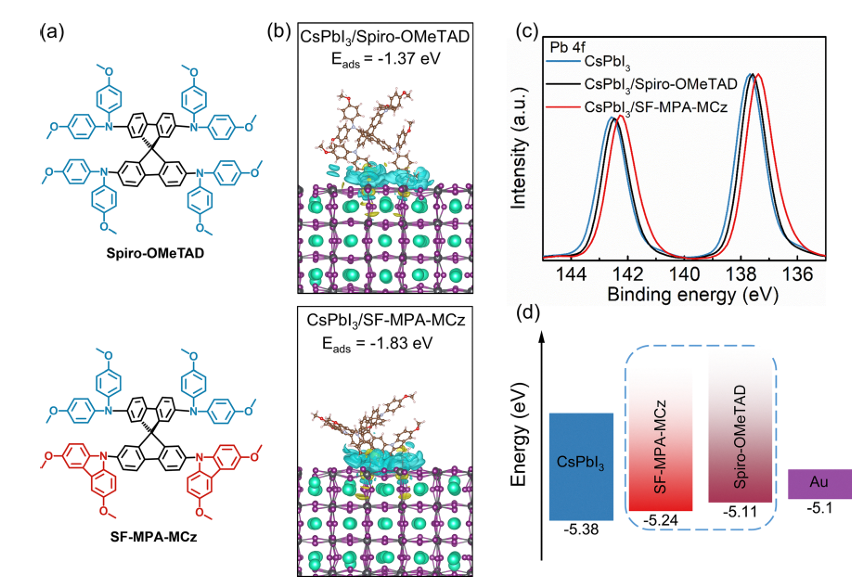
All inorganic perovskites have emerged as attractive light-harvesting materials for perovskite solar cells due to their superior thermal and photostability. However, the significant performance gap between lab-scale cells and large-area modules remains a major challenge for commercialization. Here, we introduced an anisotropically engineered hole transport material, 2′,7′-bis(3,6-dimethoxy-9H-carbazol-9-yl)-N2,N2,N7,N7-tetrakis(4-methoxyphenyl)-9,9′-spirobi[fluorene]-2,7-diamine (SF-MPA-MCz), which exhibited stronger interfacial adsorption and improved energy-level alignment with CsPbI3 and formed a uniform and robust hole transport layer, which enhanced both efficiency and stability. As a result, CsPbI3-based devices achieved power conversion efficiencies (PCE) of 20.0% in 0.16 cm2 single cells and 16.7% in 186 cm2 modules, representing the narrowest cell-to-module PCE gap reported for inorganic PSCs. Moreover, the enhanced interfacial coupling between SF-MPA-MCz and CsPbI3 effectively suppressed thermal degradation and ion migration, thereby improving device durability. The encapsulated module maintained 80% of its initial PCE after 1500 h of damp-heat testing (i.e., at 85 °C and in 85% R. H. air) and retained 80% of its initial PCE after 4000 h of operation under continuous 1-sun illumination at 40 °C.
DOI: 10.1039/d6tc00175k

 学校首页
 English