Hafiz M.Asfahan+, Siyuan Jia+, Syeda Mishal Zahra, Zhenyuan Xu,
Jia Zhu, Wanlin Guo, Xiuqiang Li*
Adv. Mater. (IF:29.1),First published: 14 October 2026
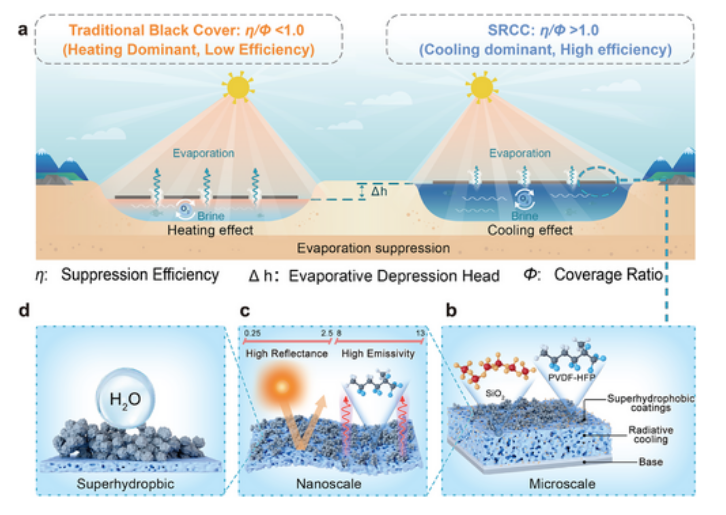
Globally, warmer lakes disrupt thermal balance, causing hypoxia, salinization, biodiversity loss, and increased evaporation. Conventional floating covers used to reduce evaporation absorb sunlight and warm the underlying water, limiting suppression efficiency to less than the coverage ratio (ηeff/Φ ≤ 1). Here, we break this limit by developing Superhydrophobic Radiative Cooling Covers (SRCC) via multi-level structural design. SRCC actively cools the water surface by combining high solar reflectance, strong mid-infrared emission, and superhydrophobicity. Experiments show SRCC lowers water temperature by 2.2°C versus uncovered water, achieving 93.1± 0.1% evaporation suppression at 91% coverage, yielding ηeff/Φ > 1.0 for the first time. Large‑scale simulations for nine Chinese lakes indicate that SRCC reduces water temperature by 4.87°C (vs. no cover) and by 12.44 °C (vs. black covers). This cooling could increase annual freshwater reserves by 10.78 km3 across China under full deployment, equivalent to 20.9 L per person per day. Unattainable with conventional covers, SRCC uniquely mitigates thermal accumulation while enhancing freshwater storage, providing a quantifiable engineering solution to climate‑driven water stress and enabling adaptive lake ecosystem management across regional and global scales.

 学校首页
 English