Yong Gao, Yunyun Xu, Lingjie Yuan, Zhenwen Yu, Mengyue Liu, Ruize Xu,
Kun Chang*, Yinlong Zhu*, Zhong-Shuai Wu*
Adv. Mater.(IF:29.1),Pub Date : 2026-10-10
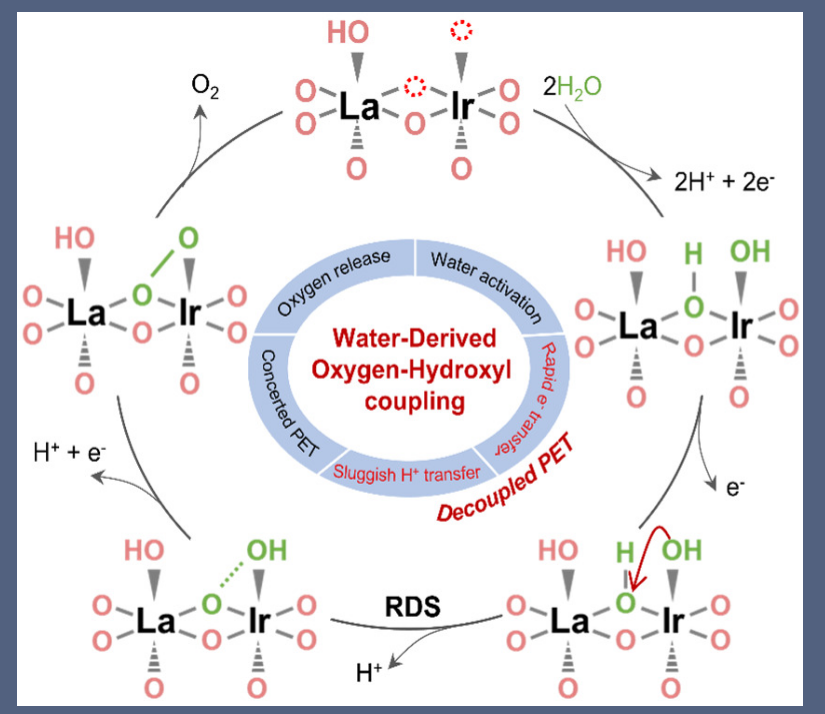
Developing highly stable, low-iridium catalysts is critical for acidic oxygen evolution, but is limited by structural degradation driven by acid corrosion and voltage polarization. Herein, we report an iridium and lanthanum co-doped manganese-cobalt spinel catalyst, Ir,La-MCOδ, featuring octahedral La-Ir pairs (Laoct-Iroct) with a theoretical favorable configuration of adjacent bridging and Ir z-axis oxygen vacancies. This low-Ir catalyst Ir,La-MCOδ (0.12 mg Ir cm-2) exhibits an overpotential of merely 220 mV at 10 mA cm-2 in pH = 1 electrolyte, and demonstrates robust operation for over 1550 h at 1 A cm-2 in a proton exchange membrane (PEM) water electrolyzer. Coupled (quasi)in situ characterizations and operando spectroscopy reveal that the adjacent oxygen vacancies mediate the evolution of oxygen intermediates, enabling water-derived oxygen-hydroxyl coupling with negligible lattice oxygen involvement, via a decoupled proton-electron transfer pathway. This mechanism preserves the structural integrity of the catalyst and yields a calculated reaction free-energy change of merely 0.38 eV (U = 1.23 V) for the most unfavorable oxygen-hydroxyl coupling elementary step, thereby endowing Ir,La-MCOδ with exceptional durability. This work provides a valuable mechanistic insight into designing highly stable defective catalysts.
doi.org/10.1002/adma.75352

 学校首页
 English