Peng Xu, Xinzhu Li, Xuezheng Liu, Xinyu Zhao, Jinzhan Cheng,
Wanlin Guo, Xiaoming Zhao*
Interdiscip. Mater.(IF:22.5),First published: 06 October 2026
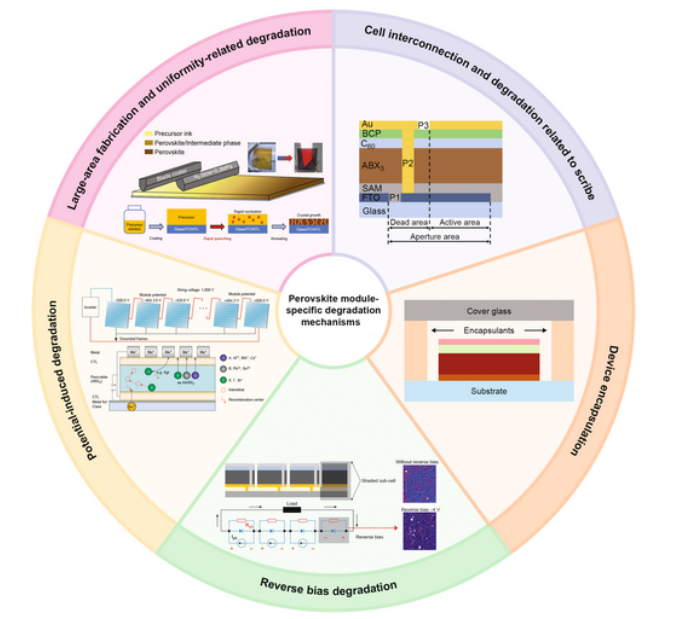
Perovskite solar cells have achieved remarkable progress as the third-generation photovoltaics (PVs), owing to their low manufacturing cost and high-power conversion efficiency, and are now advancing toward industrialization. However, poor long-term operational stability remains a key obstacle to their industrial commercialization. In particular, when scaling from millimeter-scale devices to perovskite solar modules (PSMs), the increase in module dimensions, variations in fabrication processes, and the influence of practical operating conditions introduce a series of degradation mechanisms specific to PSMs. To provide a clear understanding of stability challenges at the module level, this review systematically summarizes the degradation mechanisms unique to PSMs. Starting from fundamental fabrication processes and operational principles, we comprehensively analyze degradation phenomena associated with uniform film formation, interconnection architecture, encapsulation design, and thermoelectrochemical stability. In addition, recent progress in mitigation strategies addressing these stability issues is summarized and organized. Finally, perspectives on future research directions in module stability are briefly discussed to provide practical guidance for developing reliable, durable, and commercially viable perovskite PV modules.
https://doi.org/10.1002/idm2.70092

 学校首页
 English