Xin Wang, Hongwei Zhang, Xinzhu Li, Yuchen Song, Ziang Pan, Junyi Lu, Jinzhan Cheng, Peng Xu, Xiangnan Sun, Xueling Zhao, Lifei Chen, Tianjun Liu, Huaqing Xie*, Xiaoming Zhao*
Angew. Chem. Int. Ed.(IF:17.6),First published: 08 September 2026
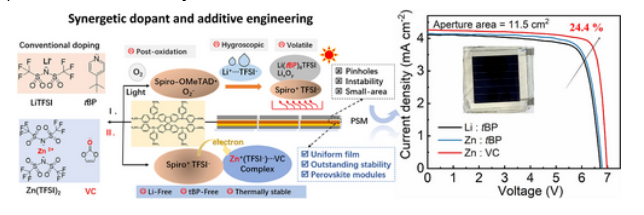
The spiro-OMeTAD hole-transport layer (HTL) underpins high-performance n–i–p perovskite solar cells (PSCs), but conventional hygroscopic lithium dopants and volatile additives undermine operational stability and complicate module fabrication. Here we introduce a synergistic dopant–additive strategy that replaces both with a thermally stable Zn salt and vinylene carbonate (VC). The Zn:VC combination oxidizes spiro-OMeTAD without air, promotes p‑radical formation, and raises the HTL glass-transition temperature above 150°C. Consequently, we achieved a power conversion efficiency (PCE) of 26.3% for unit cells (0.16 cm2) and 24.4% (23.96% certified) for modules (11.5 cm2)—among the highest reported for n–i–p perovskite modules. Modules retain 90% of initial efficiency after 2000 h damp‑heat exposure, 96% after 2500 h maximum‑power‑point tracking, and exhibit stable output over 30 days outdoor, demonstrating markedly improved operational robustness.

 学校首页
 English