Xin Wang, Ziang Pan, Jingyao Feng, Lifei Chen*, Yuchen Song, Wenkai Liao, Peng Huang, Yifan Li, Jianguang Xu, Feng Wang*, Xiaoming Zhao*
Adv. Energy Mater(IF:25.1),First published: 30 August 2026
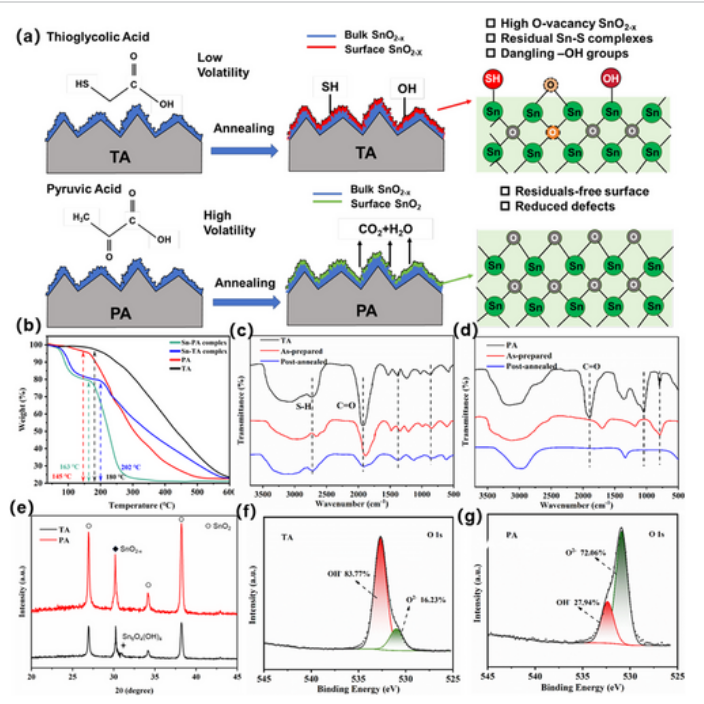
SnO2 is a benchmark electron transport material for perovskite solar cells (PSCs). However, SnO2 films from the conventional chemical bath deposition (CBD) are limited by impurities and defects that accelerate non-radiative recombination and compromise device stability. Here, we present a volatile additive engineering strategy using pyruvic acid (PA) as a dual-functional nucleation promoter and surface modulator during SnO2 deposition. Owing to its volatility (sublimation at 145°C), PA can be effectively removed during annealing, resulting in cleaner SnO2 surfaces with reduced residual groups. This is accompanied by a decrease in oxygen-related defect densities in the SnO2 layer. This improvement leads to enhanced charge recombination and improved thermal stability at the buried interface. Consequently, PA-engineered PSCs achieve a power conversion efficiency of 26.17%, together with improved device stability, retaining >80% of their initial efficiency after 900 h of continuous operation, 1000 h at 65°C, and 30 days under 30% relative humidity. Furthermore, this approach is compatible with large-area fabrication, yielding efficiencies of 24.83% for 1 cm2 lab-scale cells and 20.21% for 30 cm × 30 cm industrial-scale solar modules. These results suggest that controlling additive volatility improves CBD-SnO2 quality and offers a promising route for stable, scalable perovskite solar cells.

 学校首页
 English