M. Xu†, R. Wang†, Z. Wang†, Z. Tang, W.-H. Huang, W. Tan, L. Yuan, H. Tao, Z. Dong,
M.-H. Yeh, C.-W. Pao, J. Yin, Z. Hu, J. Dai*, Y. Zhu*
Nat. Commun. (18.1),Published:
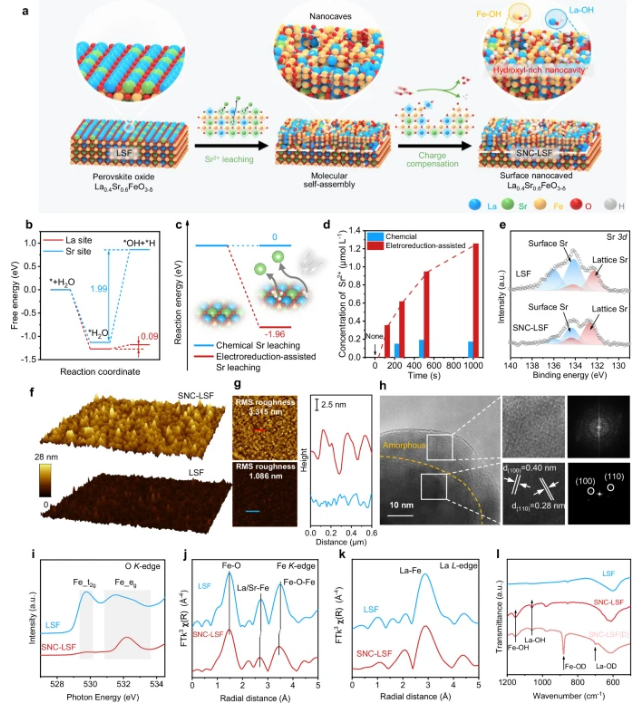
Electrocatalytic nitrate reduction to ammonia (NITRR) provides a sustainable avenue for simultaneous nitrate mitigation and ammonia synthesis, but the sluggish surface hydrogen migration during NITRR remains a major bottleneck. Here, we show a barrierless hydrogen transfer pathway along intramolecular hydrogen bonds between hydroxyls of hydroxyl-rich nanocavities for efficient nitrate electroreduction to ammonia. This nanocavity is constructed via electrochemical reduction-assisted selective Sr ions leaching on the La0.4Sr0.6FeO3-δ perovskites. Combined experimental and theoretical investigations reveal that the nanocavity features nanocavity-like architecture with hydroxyl-enriched walls, boosting active hydrogen generating and hopping for NO3- hydrogenation. Benefiting from such unusual intramolecular hydrogen transfer, the surface nanoconcaved La0.4Sr0.6FeO3-δ achieves a Faradaic efficiency of 97.81 % and an ammonia yield rate of 51.37 mg h−1 cm−2 at −0.8 V versus reversible hydrogen electrode (RHE), surpassing nanocavity-free counterpart and ranking among superior NITRR catalysts. Ampere-level current density of nitrate-to-ammonia conversion are further realized in a renewable-energy-powered electrolyzer at a very low cell voltage of 2.23 V. Techno-economic analysis underscores dual benefits of this process including economic viability in ammonia synthesis and environmental impact in nitrate remediation.
doi.org/10.1038/s41467-026-74405-1.

 学校首页
 English