L. Yuan, S. Hong, C. Liang, B. Chen, J. Tang, C.-Y. Kuo, C.-T. Chen, T.-S. Chan, C.-W. Kao,
H. Tao, Z. Dong, M. Yi, Z. Hu, F. Gong*, Y. Zhu*
Chem Catalysis(IF:10.7),Available online 16 April 2026
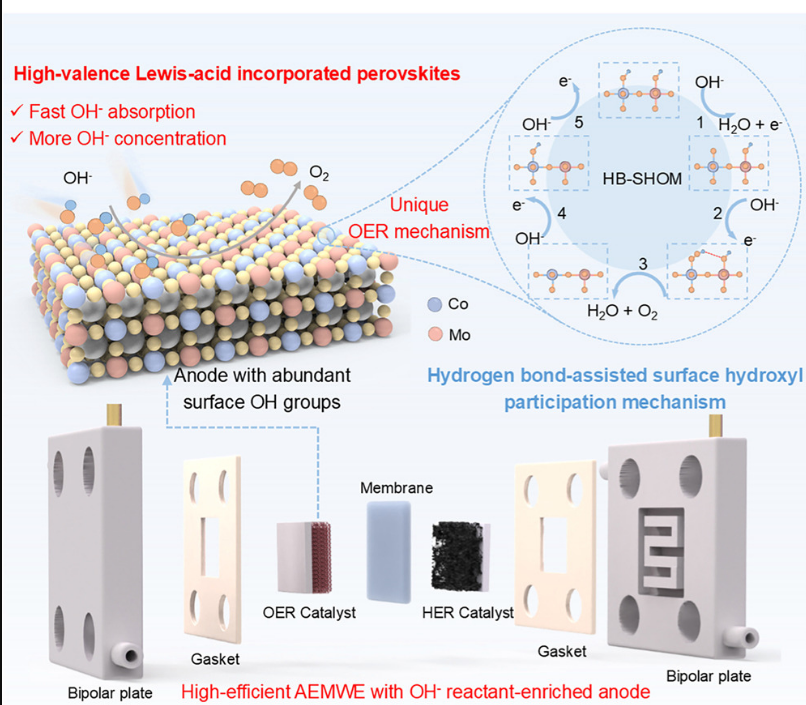
The starvation of OH− reactants around the anode surface caused by rapid consumption during the alkaline oxygen evolution reaction (OER) is a critical problem limiting the development of anion exchange membrane water electrolyzers (AEMWEs). Here, we present a high-valence Lewis acid incorporation strategy to enrich OH− adsorption for optimizing alkaline OER performance and for the first time demonstrate direct participation of surface hydroxyl in the alkaline OER. In particular, the optimized Sr2CoMoO6 (SCMO) with the strongest surface hydroxylation exhibits excellent alkaline OER activity and AEMWE device performance when adopted as a noble-metal-free anode electrocatalyst, achieving an industrial current density of 1 A cm−2 at a low voltage of 1.83 V and steadily operating for 100 h. Combined experimental and theoretical investigations verify that the surface hydroxyls in SCMO participate in the OER via an unusual hydrogen-bond-assisted surface hydroxyl participation mechanism. These findings offer new insights into hydroxyl electrocatalysis for AEMWE applications.

 学校首页
 English