B. Li†, X. Xue†, S. Hong†, C. Liang , M. Lv , W.- H. Huang , H. Tao , S.- Y. Hsu , M.- H. Yeh , J.- M. Chen , R. Qiao , N. Feng , M. Yi , Z. Hu , F. Gong* , K. Qi , Y. Zhu*
Advanced Materials(IF:29.1),Published:2026-04-14
ABSTRACT
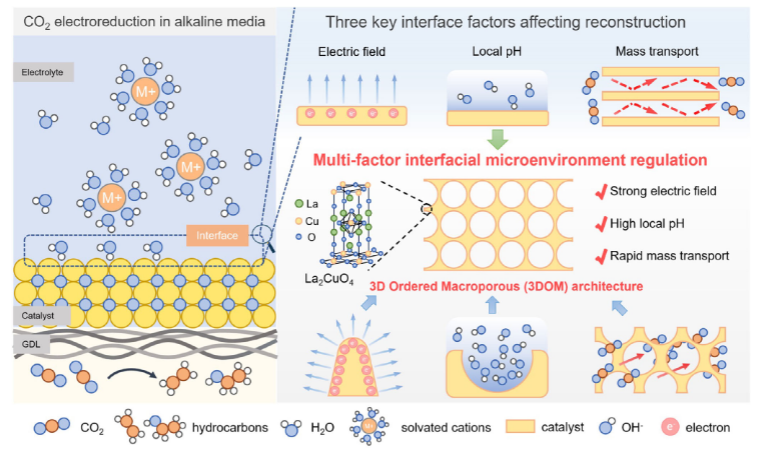
Electrochemical CO2 reduction reaction (CO2 RR) offers a compelling pathway to convert carbon emissions into value-addedchemicals, yet achieving high activity, selectivity, and durability under industrial conditions remains challenging. Thoughcopper oxides could uniquely promote C2+ electrosynthesis, their performance is dictated by dynamic oxide reconstruction,which is strongly governed by the interfacial microenvironment. Here, we report direct interfacial microenvironment regulationby constructing a 3D ordered macroporous (3DOM) architecture from layered perovskite La 2 CuO4 . The 3DOM architecturesimultaneously strengthens the surface electric field, elevates local pH, and accelerates mass transport at the interface, drivingaccelerated and complete reconstruction of La2 CuO4 into dendritic grain-boundary-rich nano-copper. Consequently, 3DOM-La2 CuO4 delivers a high C2+ partial current density of 585 mA cm−2 in a flow cell, outperforming bulk counterpart and mostreported Cu-oxide-based catalysts. In a membrane-electrode assembly, stable operation is sustained for ∼ 200 h at 600 mA cm−2with high C2+ selectivity. Combined experimental and theoretical analysis identify undercoordinated, compressively strainedCu atoms at grain boundaries as the intrinsic active sites for C2+ formation, by facilitating *COH formation, stabilizing*OCCOH intermediate, and suppressing the competing hydrogen production. This work establishes electrode-architecture-drivenmicroenvironment engineering as a general strategy for directing oxide reconstruction and designing high-performance CO2 RRcatalys

 学校首页
 English