Yiming Dai, Dongyang Lv, Weicun Chu, Cheng Wang, Luyao Li, Jiaxing Gao, Wenjing Zheng, Chunhong Hu, Jie Sheng, Zhi Liu, Qiankai Ba, Sang Il Seok*, Riming Nie*, Wanlin Guo
Adv. Funct. Mater.(19.9),First published: 19 June 2026
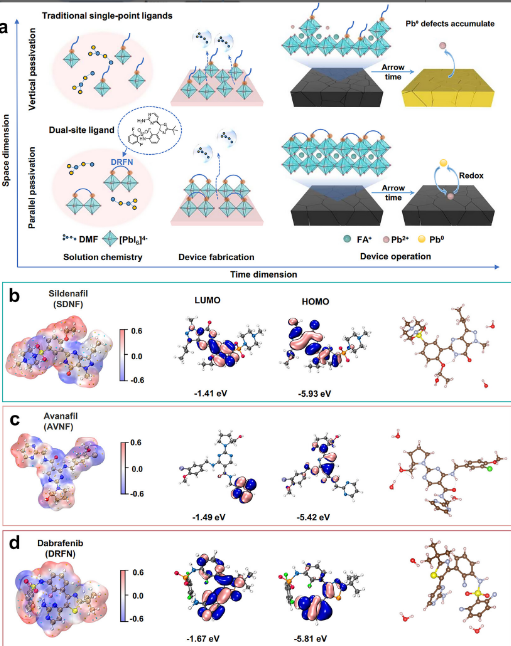
Additives and passivators are commonly used to regulate crystallization and suppress defects in halide perovskites. However, existing additives or passivation agents struggle to concurrently achieve effective defect passivation and efficient charge transport, and their passivation effects often fail to endure throughout device fabrication and operation. Here, we systematically screened a series of redox-active, bifunctional passivation molecules with various functional motifs, namely sildenafil (SDNF), avanafil (AVNF), and dabrafenib (DRFN), to achieve spatial defect passivation and temporal redox healing in perovskite films. Spatially, the sulfonyl (-SO2-) group and heterocyclic nitrogen of DRFN coordinate with perovskites at dual sites, enabling parallel binding to multiple Pb2+ centers. Temporally, its sulfonyl group exhibits moderate electron-withdrawing capability, facilitating redox-mediated defect healing by reducing metallic Pb0 species. These combined effects yield peak power conversion efficiencies of 25.28% in the n-i-p configuration and 26.62% in the p-i-n configuration, along with exceptional thermal and operational stability. The unencapsulated device efficiency shows almost no degradation after 1200 h under continuous maximum power point tracking.

 学校首页
 English