Xiangnan Sun, Peng Xu, Xitao Li, Xinyu Zhao, Wei Zhang, Xin Wang, Zhenhu Zhang,
Wenda Shi, Wanlin Guo, Xiaoming Zhao*
Adv. Energy Mater.(IF:24.4),First published: 26 November 2025
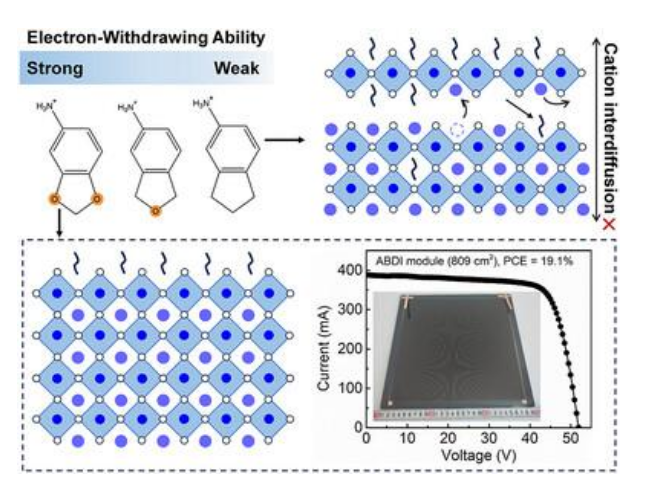
2D/3D perovskite heterostructures have advanced the performance of perovskite solar cells. However, ion diffusion at the 2D/3D interface under illumination and prolonged heat affects device stability and scalability. Here, we studied the electron-withdrawing strength of aromatic ammonium ligand on perovskite interface stability. We tuned the electron-withdrawing strength of the ligand through the incorporation of oxygen atoms on heterocyclic rings, and found that the ligand possessing the strongest electron-withdrawing capability effectively suppresses 2D formation while preventing cation interdiffusion and maximizing defect passivation, outperforming conventional 2D/3D strategies. Consequently, we achieved power conversion efficiencies of 26.1% in 0.16 cm2 lab-scale cells and 19.1% in 809 cm2 industrial-scale solar modules. These encapsulated modules exhibited excellent damp-heat (85°C/85% relative humidity) stability and operational durability, with <10% efficiency loss after 2500 and 3000 h, respectively. Moreover, the modules maintained steady power output over 30 days of outdoor operation, underscoring their potential for practical real-world applications.

 学校首页
学校首页 English