Liangpu Lv,Yiding Chen,Kelan Zhang,Hongyang Ma,Dan Zhu,
Wei Deng*,Jun Yin*,Wanlin Guo
ACS Appl. Mater. Interfaces(IF:8.5),Published December 15, 2025
Abstract
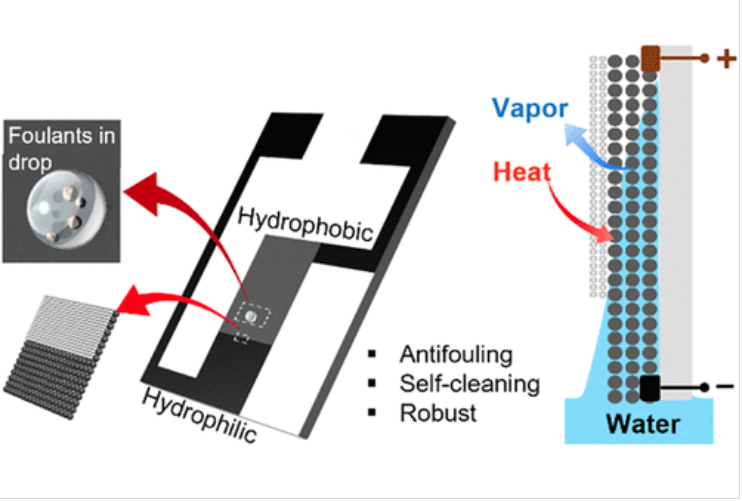
Leveraging water–solid interactions, hydrovoltaic technology converts ambient thermal energy to electricity through ubiquitous water evaporation. While substantial research efforts have focused on improving the electrical output of evaporation-induced electricity generation (EEG), the antifouling capability and long-term durability of such devices in real-world environments remain largely unaddressed. In this study, we designed a Janus dual-layer EEG device in which a top superhydrophobic layer protects a bottom hydrophilic electricity-generating layer. The nanoporous superhydrophobic layer permits water vapor transmission from the underlying evaporative layer while effectively repelling liquid water and various types of foulants. The Janus EEG device achieved an open-circuit voltage of ∼1.1 V and maintained stable performance when exposed to particulate contaminants and intermittent water dripping, whereas the output of a single-layer EEG device ceased due to overwetting of the evaporative layer. Moreover, the superhydrophobic layer functioned as a protective plastron to preserve the structural integrity of the evaporative layer under impact from falling water drops. One-week-long outdoor test confirmed the superior performance of the Janus EEG device over its single-layer counterpart under various weather conditions and fluctuating ambient temperature and humidity. Our work proposes a promising Janus dual-layer design and highlights enhanced antifouling and durability as a key pathway to all-weather hydrovoltaic applications.

 学校首页
学校首页 English