Xiaofan Wang*, Xiaokai Chen, Yuyang Long, Jinguo Liu, Fanrong Lin,
Jun Yin, Yanpeng Liu *& Wanlin Guo *
Nat Electron(IF:49.1),Published:
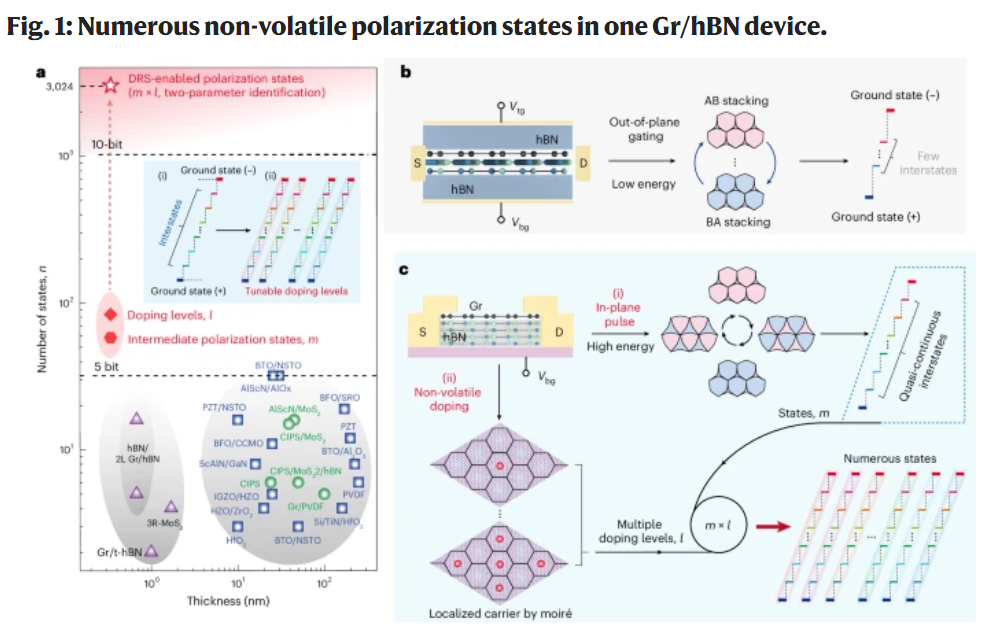
Creating multiple polarization states in a single ferroelectric device is of use in neuromorphic computing to enhance computational resolution. However, the number of stable polarization states in such systems is typically limited to 32 at room temperature. Here we report the manipulation of thousands of non-volatile polarization states at room temperature in a sliding ferroelectric transistor that is composed of an aligned graphene monolayer atop hexagonal boron nitride. Solely regulated by source–drain pulses, more than 36 quasi-continuous polarization states can be generated at one doping level. Superimposing a gate voltage during the source–drain pulses can reversibly regulate the graphene Fermi energy between 84 doping levels, promoting the number of physically distinct polarization states to 3,024 (36 states × 84 doping levels). These polarization states can sustain for over 105 s and could potentially persist for 10 years. The abundant polarization states probably stem from the motion of polar domain walls and the moiré potential localizing the injected carriers. The simulation of during-training quantization in a deep residual network using the 3,024 polarization states shows a floating-point-comparable recognition accuracy (around 93.53%) for fashion images.
https://doi.org/10.1038/s41928-025-01551-7

 学校首页
学校首页 English