学校首页
学校首页 English
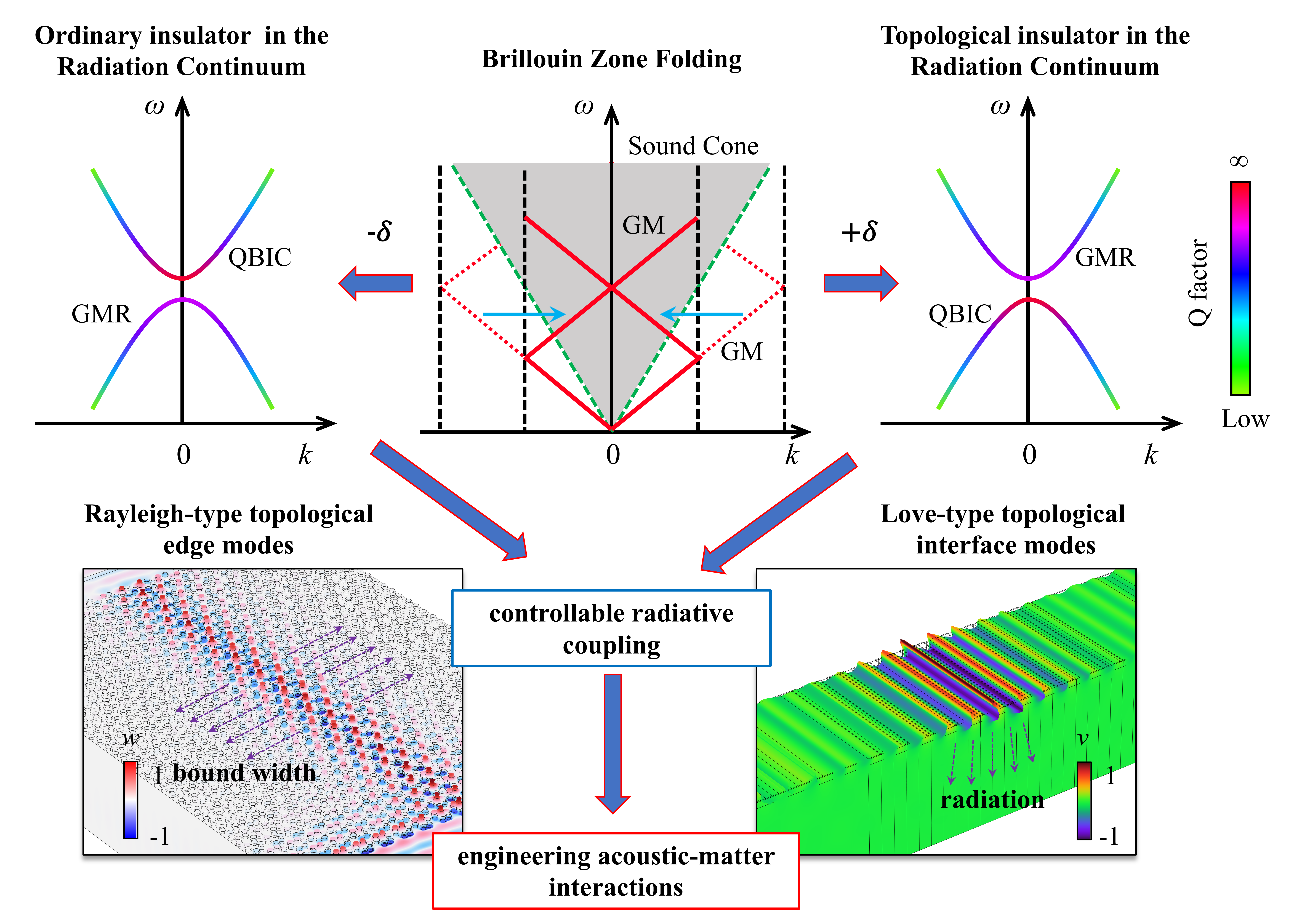
Conventional theory holds that high quality factor (Q) surface acoustic wave modes cannot exist within the radiation continuum due to inevitable coupling with bulk modes. Here we demonstrate that Brillouin zone folding enables the emergence of two types of high-Q resonances—bound states in the continuum and guided mode resonances—within the sound cone. Using rigorous theoretical analysis, we reveal that these resonances can be robustly sustained and their Q tuned across a broad spectral range via controlled structural perturbations. We numerically validate our predictions on two distinct platforms: topological Rayleigh-type edge modes supported by periodic resonator arrays on a piezoelectric half-space, and topological Love-type interface modes in groove-type phononic crystals on heterogeneous substrates. These surface-confined modes exhibit controllable radiative coupling, providing a versatile mechanism for engineering acoustic-matter interactions. Our results establish a unified framework for accessing high-Q surface acoustic waves in the continuum, with implications for chip-scale acoustic devices in sensing, microfluidics, and non-Hermitian acoustics.
DOI:https://journals.aps.org/prb/abstract/10.1103/sxfs-mbqj